
on 18/05/2026
Written by Swati Salvi, Seymour College
In Year 7 Science at Seymour College, our Biodiversity unit was designed to help students develop an understanding of ecosystems and environmental sustainability through both Western Scientific and Indigenous perspectives. Rather than treating Indigenous knowledge as an additional component, the unit intentionally integrated multiple knowledge systems throughout the learning sequence so students could recognise different ways of understanding and caring for the natural world.
The unit began with students developing foundational scientific knowledge through classification systems. Students learned how organisms are grouped based on shared characteristics and explored the purpose of classification in understanding biodiversity. This provided students with a scientific framework for identifying relationships between living things before extending their thinking to broader ecological connections.
Students then explored Indigenous seasonal calendars and life cycles, comparing these with the traditional Western four-season model. Through this learning, students examined how Aboriginal and Torres Strait Islander Peoples use careful observation of plants, animals, weather patterns, and seasonal change to understand ecosystems and care for Country. Many students were fascinated by the idea that environmental changes and animal behaviours can act as indicators of seasonal transitions, highlighting how scientific observation exists within multiple knowledge systems.
 |
 |
To strengthen students’ connection to their local environment, students completed a short biodiversity “spot survey” in nature, where they observed and recorded organisms, interactions, and environmental conditions within the school environment. This activity encouraged students to slow down, observe carefully, and apply both scientific observation skills and Indigenous perspectives of connection to place.
Students then investigated the impact of abiotic factors on Australian ecosystems, including temperature, rainfall, water availability, and natural disasters. This helped students connect biodiversity concepts to real-world environmental challenges and understand how changes in environmental conditions can influence the survival of species and ecosystem stability.
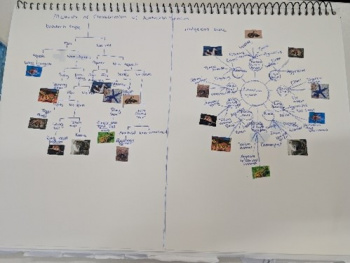
The learning sequence culminated in a collaborative ecosystem simulation activity. Students worked in teams to construct food webs and ecological pyramids representing different Australian ecosystems. They then introduced environmental stressors such as habitat destruction, invasive species, pollution, climate change, and human activity to observe how biodiversity and ecosystem balance were affected. This activity allowed students to visually and physically model the interconnectedness of ecosystems while exploring the complexity of environmental management.
 |
 |
A key focus of the final discussions was understanding that effective environmental policies and conservation strategies should not rely solely on one knowledge system. Students explored how Indigenous ecological knowledge and Western Scientific approaches can work together to support sustainable land management and biodiversity conservation. These conversations helped students recognise the deep knowledge Traditional Custodians hold about the land through generations of observation, connection, and care for Country.
Throughout the unit, students demonstrated strong engagement with the collaborative and inquiry-based learning experiences. Reflections showed increased confidence in discussing environmental issues, stronger critical thinking skills, and greater openness to diverse perspectives. Many students began to move beyond viewing science as isolated facts and instead recognised it as a way of understanding relationships within the environment and society.
By integrating multiple knowledge systems authentically, the unit encouraged students to see biodiversity not only as a scientific concept, but also as a shared responsibility that connects people, culture, and the natural world.
Share:


