

on 02/11/2026
Written by Rhys Morgan.
I want to take you back to your first year of teaching.
Do you remember your first practical lesson?
Did it work?
Were you worried about behaviour, safety, or whether the whole thing might fall apart?
Those are exactly the questions I’ve been asking myself this year as a first-year teacher at Roxby Downs Area School.
For context, RDAS has a science lab that has been underutilised and somewhat disorganised for a while. The team have done an amazing job with the resources available to them, but it has been some time since the lab was loved and looked like a space that was ready for learning. Since the lab has not been given much TLC, many of the students have struggled to feel engaged and ready for science learning.
Jumping into the desert this year, I’ve faced many challenges in engaging my students in regular, ‘fun’, educational experiments. Either they ask 1,000 questions or they refuse to enter the lab on a hot Friday afternoon. Whilst I know I’m surrounded by like-minded colleagues; I’ve found myself sifting through our chemical cupboards and slowly starting to figure out how to make sense of it all. Part of this journey has been uncovering archived lesson plans from 2007 and chemicals to match! With my first-year lab tech, we are getting there.
On top of that, as a first-year teacher, I still doubt my teaching from time to time. My behaviour management and practical skills need work, but that’s to be expected…I mean who hasn’t had to clean up the lab after your students, or accidentally burn yourself on a Bunsen burner?
The township of Roxby Downs brings with it a number of interesting challenges as a school site The realities of remoteness, shift work, and a transient workforce can create additional barriers to sustained engagement in academic learning. Coupled with the regular turnover of staff, this can lead to student disengagement and a perception that science is not for them. Colleagues in the past have said “they can’t be trusted” in the lab because they are too unruly, or the behaviours are too complex.
I would argue that we risk creating a self-perpetuating cycle: if we do not challenge these assumptions, students miss out on the very experiences that build curiosity, responsibility, and confidence in science. Students will not appreciate the joy and curiosity of scientific learning if they are not able to learn through practicals and experiments.
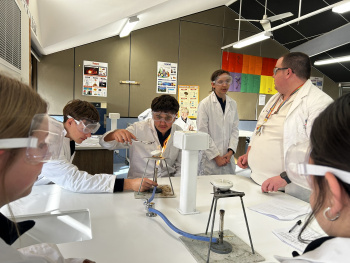
And so, that is what we have done. Over the past 2 terms we have performed photosynthesis, dissected hearts, explored chemical reactions, simulated radioactivity, and explored atomic spectra. Doing all of that with a Year 9 class on a Friday afternoon in the final lessons of the day has been no small challenge.
But credit where credit is due, the students have risen to the challenge. Their growing enthusiasm, interest, and capacity to carry out practicals speaks volumes. Anecdotally, student attendance, enthusiasm, and willingness to engage in science has increased.
For the first time in a very long time, RDAS participated in National Science Week, utilising BHP outreach resources to encourage STEM roles at Olympic Dam. The exposure is key. By having students see the fun and hands-on activities available in science, we are changing the perception of science as a discipline, lesson by lesson. At the end of the day, these students are leaving with an understanding and appreciation for the lab, even if it doesn’t show in their academic learning. What has changed most is not just the lab. It is students’ belief that science is something they can do, and our belief that they can be trusted to do it.
Share:


