

on 15/09/2025
When we take learning outdoors, we don’t step away from the curriculum, we step into it. Nature creates the conditions where engagement and wellbeing thrive, and where students practise the habits of science; noticing, questioning, testing, recording, and reflecting.
At Seacliff Primary School, an eight-week Thriving Learners pilot supported by the Department for Education took upper primary students on repeated visits to Tulukutangga (Kingston Park Coastal Reserve) on Kaurna Country. The focus was to explore how outdoor, student-centred learning could enhance wellbeing literacy, deepen engagement, and build the dispositions and capabilities that sustain learning.
Spending time in nature was a vital part of the program’s approach, reflecting research that positions nature as an essential component of a “balanced diet” of childhood experiences (Gill, 2014). These experiences support healthy development, wellbeing, and environmental attitudes, while also contributing to overall health (Chawla, 2015).
 Journals that inspire noticing, language and confidence
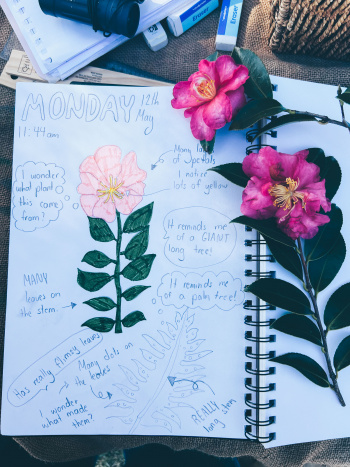
Nature journaling invited learners to slow down and use curiosity to notice and wonder about the natural environment. Each session included time for journalling, often supported by a nature walk or foraging for inspiration.
Nature journaling isn’t about creating beautiful artwork, although it can foster those skills; it’s an observation activity. It offers students an opportunity to sharpen their observation skills, ignite curiosity, and engage with natural phenomena as scientists do. And all you need to get started is some paper and a pencil.
We used a framework developed by John Muir Laws and Emilie Lygren, from the excellent (and free) resource How to Teach Nature Journaling. It is driven by three simple prompts: I notice, I wonder, it reminds me of. These prompts help students shift from simply seeing to truly noticing, cultivating observation, sparking inquiry, and making connections, the very habits at the heart of science.
Research suggests that nature journaling and reflective storytelling help children articulate emotions and thoughts, with drawings and discussions revealing strong links between access to nature and wellbeing indicators (Moula et al., 2021). This was evident at Seacliff, where students described what they were learning through close observation: “Yeah, you learn the close-up, intricate details and what it (the observed item) is really made out of!”.
Journalling also supported expressive language for wellbeing. As one student reflected: “I am thankful. I am happy. I am inspired by how many details I missed from not looking more carefully”.
Program outcomes confirmed this impact. Students moved from knowing that nature supports wellbeing to expressing that connection with confidence through journalling, storytelling, and reflection.
Journalling developed careful observation and language. Play took those same habits of science into the landscape, where students could iterate; navigating ideas, adjusting approaches, and trying again. It was also where the dispositions and capabilities came to life: curiosity in discovery, resilience in challenge, collaboration in shared building, and mindfulness in moments of reflection. In these rich natural settings, iteration and play created the conditions for deep engagement and lasting connection to place.
Engagement through challenge, play and achievement
 Hands-on, experiential experiences in, with, and through nature drew learners into deep engagement. Students experimented with marble runs in the sand, collaborated to build cubbies from natural materials, and each took on the challenge of creating their own five-minute fire using flint and steel. These activities fostered persistence, problem-solving, and creativity, while grounding learning in the textures, stories, and possibilities of the coastal landscape.
The sense of achievement was clear. “I did it! I made fire!” Students articulated challenge, persistence, and reflection in sequence:
* “It was frustrating because every time I got it, it went out. But I had persistence.”
* “I had hope. When it was lit, it was amazing! And so, you’d try again.”
* “I don’t know the word for it, but you had to keep going.”
* “Resilience,” another child offered.
* “Yeah, resilience!”
The emotional tone of these experiences was positive and grounded in place: “I feel very happy today: peaceful, playful, and proud.”
Outcomes that matter for wellbeing and engagement
 By the end of the program, students strengthened their ability to use nature to support wellbeing and to explain how and why it helps. They grew in confidence to communicate this connection through movement, journalling, and storytelling. Their enjoyment of natural spaces increased, and students displayed a stronger personal connection to nature, both socially and emotionally.
The appetite for more learning outdoors was explicit. As the program progressed, students began imagining what their learning could look like if they had more time in nature. Their suggestions reflected both a desire for depth and a recognition of the joy they felt in outdoor settings:
- “A longer block.”
- “A whole day, so we don’t feel rushed.”
- “Twice a week.”
- “An overnight camp to see stars.”
- “Yeah! Just expand it!”
These reflections show that the experiences were not only memorable but also motivating. Students wanted to extend them, to slow down, and to see what might emerge if learning outdoors became a regular part of school life.
For science teachers, the message is clear. When wellbeing and engagement are nurtured outdoors, students thrive emotionally and develop the dispositions and capabilities that make science learning meaningful and lasting. Nature in education is not an extra but something essential.
Further reading and resources:
- Connecting Outdoor Learning and Wellbeing with Seacliff Primary School
- How To Teach Nature Journaling
- Why Kids Whould Nature Journal at All Grade Levels
References:
Chawla, L. (2015). Benefits of nature contact for children. Journal of Planning Literature, 30(4), 433–452. https://doi.org/10.1177/0885412215595441
Gill, T. (2014). The benefits of children's engagement with nature: A systematic literature review. Children, Youth and Environments, 24(2), 10–34. https://doi.org/10.7721/chilyoutenvi.24.2.0010

Abe Moore is the Education Manager at Nature Play SA, leading a team of educators who deliver nature play programs across South Australia. With 16 years teaching experience, he is a passionate advocate for experiential learning, student agency, and progressive approaches to education.
Share:


