
on 07/09/2026
by Dr. Jatinder Banvet, Mark Oliphant College
My recent Ediacara Teachers' Trip Experience in the Flinders Ranges was an inspiring opportunity to step into one of the most remarkable chapters of Earth’s history, in the very landscape where its evidence has been preserved for more than half a billion years. Standing amongst these ancient rocks and learning about the Ediacaran Period (approximately 635–538 million years ago) brought geological time, fossilization and sedimentary rock formation to life in a way that a textbook simply cannot.
Learning about remarkable Ediacaran organisms such as Dickinsonia, Spriggina, Parvancorina and Tribrachidium reinforced for me just how globally significant South Australia is to our understanding of the history of life on Earth. It also highlighted the enormous potential of our local environment to foster authentic, place-based science learning that sparks students' curiosity.
Since returning, I have been developing resources and inquiry-based learning tasks to introduce next term in my Year 8 Earth and Space Sciences unit. These resources are being aligned with the Australian Curriculum (ACARA) and the South Australian Curriculum, using the Flinders Ranges and Ediacaran fossils as a meaningful local context for exploring the rock cycle, sedimentary rocks, fossilization, plate tectonics, geological evidence and changes to Earth over deep time. The learning tasks will encourage students to observe evidence, ask questions, interpret geological clues and construct their own scientific explanations.
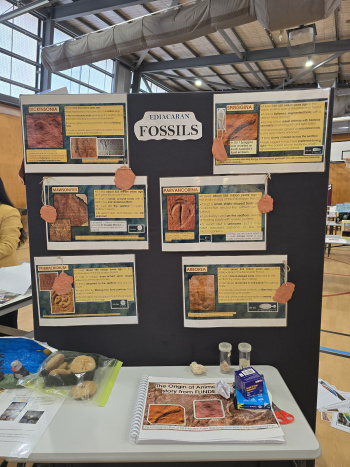
 One of the highlights was sharing my Ediacara experience with our wider school community at our school Science Fair. My display brought together photographs, information, rocks, fossil-related materials and examples of the learning resources I am currently developing for my Year 8 students. The response was amazing. Students, staff and visitors stopped to explore, ask questions and discuss the fossils, and many were fascinated to discover that evidence of some of Earth’s earliest complex life can be found right here in South Australia.
This experience has reinforced for me how powerful science learning can be when students connect classroom concepts with real places, real evidence and real scientific stories. I am deeply grateful to SASTA and everyone involved in making this wonderful experience possible. It has enriched my own understanding and inspired the resources and learning experiences I am now preparing for my Year 8 students next term. I hope it will encourage them to look at an ordinary rock with curiosity and ask: “What story could be hidden inside it?”
Share:


