
on 12/10/2026
By Sue Pratt, SA Lead Agriculture Teacher
Misconception #1: You need a school farm to teach agriculture
While school farms are an amazing education resource that can offer unique agricultural experiences for students, they are not essential for a great ag program. Successful programs are using facilities with a small footprint such as lab spaces, high-tech greenhouses and vertical growing systems. They strengthen the practical components by positive partnerships with industry, local businesses, researchers and universities, giving students authentic learning experiences beyond the school gate.
Misconception #2: Agriculture isn’t in the Australian Curriculum
Agriculture may not have its own subject section in the Australian Curriculum, but it does feature in more than 160 content descriptors. Importantly, food and fibre production is one of the four contexts that students should be taught about within their Technologies programs. There are also specific food and fibre content descriptors within Science and Humanities and Social Sciences and it also provides the perfect context for skill development in Mathematics.
The Australian Curriculum, Assessment and Reporting Authority (ACARA) has created the Curriculum Connections Food and Fibre resource which highlights the key components related to agriculture. With sustainability as one of the three ACARA cross-curricula priorities, food and fibre programs deliver great outcomes for students.
View the Curriculum Connections Food and Fibre resource on the ACARA website: https://www.australiancurriculum.edu.au/resources/curriculum-connections
Misconception #3: There’s no point doing agriculture if I live in a city or town and don’t live on a farm
Every student eats, wears clothes and relies on natural resources. Learning about food and fibre production helps create informed consumers who will understand the systems being used and make their purchase decisions based on facts rather than emotions. Food security, climate change, biosecurity and sustainability make agriculture relevant regardless of where students live.
In fact, half of Australians working in agriculture live in metropolitan areas. This is because many careers involve research, consulting, technology development, finance or working in government rather than owning or working on a farm. Approximately 30% of ag jobs are actually on-farm, making it a career pathway that is open to everyone.
Because ag is such a diverse and ever-changing industry, there will always be a role for you in agriculture, no matter what your skill set.
Misconception #4: Agriculture has limited career opportunities.
Australia faces ongoing shortages of skilled workers across agriculture, food and fibre industries with the current statistics showing there are six jobs available for every ag graduate. Opportunities exist from apprenticeships through to postgraduate research.
South Australia's agriculture and food sectors are becoming increasingly knowledge-intensive, with growing demand for skills in automation, digital agriculture, data analysis, soil science, climate, natural resource management, nutrition, welfare, sustainability and advanced engineering. While grains and livestock are major industries, SA also has significant wine, horticulture, almonds, seafood, poultry, dairy, pork, forestry, aquaculture, seed production and protected cropping industries, all looking for their ‘next crop’ of employees. SA is in the fortunate position of having strong education and employment pathways through universities, vocational training providers, research organisations, agribusinesses and major exporters.
A great resource to connect you with agricultural opportunities is the Student Compendium, an incredible collection of work experience opportunities, scholarships, competitions and more, created by the Ag Institute and Adelaide University Ag Students Association.
Your school should have a hard copy of the compendium, but you can find a PDF version online: https://www.aginstitute.com.au/student-compendium/sa-student-compendium/ .
Misconception #5: I don't know enough about agriculture to teach it
Well, this is where I come in! You probably know more than you think. Agriculture provides authentic and engaging contexts for science, geography, mathematics, technologies, economics, English and careers education. If you are an expert in these fields, it is easy to add an ag flavour to help bring key concepts to life.
There are so many high-quality, industry endorsed resources to support you to teach about food and fibre, starting with the Primary Industry Education Foundation of Australia’s (PIEFA) great websites. My own curriculum resources can be found on the AgCommunicators website and the SA Department for Education has eight great units of work on Plink. They can be found under Technologies but they also have strong connections to Science, particularly science inquiry skills and science as a human endeavour.
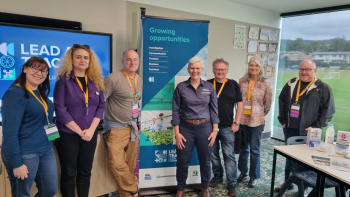
My role as Lead Agriculture Teacher (LAT) is funded to support food and fibre education programs in all sectors and across all year levels, for free! Please contact me sue.pratt@agcommunicators.com.au and we can chat about what ag could look like at your site and how to get started.
View the PIEFA websites at https://primezone.edu.au/ and https://www.careerharvest.com.au/
View Sue Pratt’s curriculum resources at https://agcommunicators.com.au/education-resources/
AgCommunicators’ Lead Ag Teacher has visited 92 schools and supported over 220 teachers to deliver high-quality agriculture programs. Sue Pratt can visit your school or catch up online to plan how your school could integrate more food and fibre into the curriculum.
The Lead Ag Teacher position is funded by the SA Grain Industry Trust and the SA Sheep Industry Fund.
Share:


