

on 11/05/2026
Authors: Jenny Woodcock, M.Ed STEM - Gawler & Districts College and Dr Katrina Elliott, PhD Science Education
Patterns, order and organisation are one of the 6 Key Ideas of the Australian Curriculum: Science.
The key ideas are designed to:
- provide lenses by which we can make sense of the world,
- support teachers and students to make connections across the interwoven strands of science,
- support the coherence of science understanding within and across year levels throughout Reception to Year 10
What’s important is that the Key ideas and the understanding that sits beneath them are equally relevant to students who want to go on and work in science as it is for those who want to live with an appreciation of science.
Science is about explaining observed patterns
Understanding patterns is central to how scientists make sense of the natural world (Harlen, 2015) – recognising similarities and differences, identifying uncertainties, predicting phenomena and constructing explanations. Pattern seeking is both a scientific habit of mind and a driver of inquiry. Including approaches that prompt students to ask deeper questions, make connections, and engage in evidence-based reasoning.
Pattern seeking can pique students' curiosity in science. Building on students' prior knowledge and experience with enough information, but not too much, creates the “curiosity sweet spot”. The sweet spot has an emotional consequence; it feels like a mental itch, a mosquito bite on the brain. As teachers, we aim to compel our students to discover new knowledge because that’s how they scratch that itch. By intentionally providing opportunities for students to experience curiosity, we provide that physical pull which motivates and stimulates students' information seeking behaviour (Abdelghani et al., 2022). Scientific thinking is intentional information seeking, including asking questions, testing hypotheses, making observations, recognising patterns, and making inferences (Corrigan & Marangio, 2020).
Why do we teach students to recognise and use patterns in science?
In 2026, the theme for National Science Week is Seeds for Science. As a science teacher (Jenny Woodcock) at Gawler and Districts College, I can think of a term full of pattern seeking fun activities which will pique my students' curiosity in biological sciences.
1. Patterns are the foundation of scientific explanations.
In my thinking and planning for a science unit on seeds. I would begin by answering these questions. What are seeds? What is their purpose? What’s inside them? One of my favourite activities is getting my students to split open seeds and investigate their physiological adaptations and functions. Dried beans, soaked overnight, work ok. But my favourite to use is defrosted, frozen broad beans. I personally enjoy listening to the squeals and groans from my students when they first touch the wet, cold and squishy broad beans. I recommend the video; What’s inside a Bean? By SciShow Kids. The students can follow along with the video to dissect their beans.
 |
 |
2. Patterns are at the heart of scientific practice.
Next, I’d have my students think and work like scientists to plan an investigation into how seeds grow. What do seeds need to successfully grow? What would happen if we changed the growing variables? Use whatever science inquiry scaffold tool suits your students’ grade and ability as a graphic organiser to communicate their scientific practice. If you are short on time, sprouts germinate and grow very quickly. Bunnings sells a variety of sprout packets. Mr Fothergill’s sprouter jar or kitchen seed sprouter makes it easy to grow, and they look nice in the classroom. While recycled jars and the use of a simple sieve to drain the water could also be used.

If you have more time, growing herbs is fun. But the lack of natural light and the diffused light from overhead fluorescent lights can make it difficult for them to successfully grow. I’ve had success using Mr Fothergill’s hydro garden from Bunnings.

3. Patterns deepen conceptual understandings.
While the plants are germinating, I’d ask my students, where do seeds come from? Pollination is a fascinating process that makes our older students cringe when scientific vocabulary is used to describe the process in flowers. Dissecting flowers is a classic science investigation. But for myself and many of my pollen allergy sufferers, I’ve had to switch to flowers preserved in resin.
4. Patterns support prediction and model-building.
Around this time in the term, we’d revisit our germination investigation. Are there any patterns or observations that have occurred that support your prediction? Do we still need more data or time before we can write our conclusions?
5. Patterns build appreciation and insight.
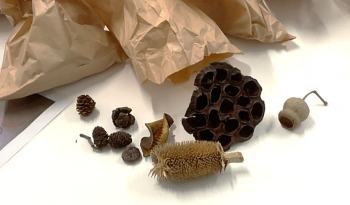
Now it’s time to examine seed pods and seed dispersal. I’d provide my students with a bag of a variety of dried seed pods. I’ve purchased my collection from Zart Art and Tea Tree Gully Early Learning Supplies. I’d ask my students to sort the seed pods into categories based on any patterns they observe. This leads to a discussion of some of the fascinating behavioural adaptations plants have to disperse their seeds.

6. Patterns support working with anomalies to strengthen scientific reasoning.
At the conclusion of the germination investigation. I’d use the Claim, Evidence, Reasoning model to support my students in writing their scientific summaries. Sentence starters help guide my students’ scientific reasoning in the right direction. Hopefully, there have been some fun growth anomalies backed up by data and observation for students to write about.
|
CLAIM |
EVIDENCE |
REASONING |
|
What do you know? |
How do you know that? |
Why does your evidence support your claim? |
|
My claim is… |
I found… |
I know this because… |
|
I think… |
My evidence is… |
This happened because… |
|
I noticed… |
The data shows… |
The reason for this is because… |
|
I believe… |
According to… |
This shows… |
|
|
|
This means… |
|
|
|
This implies… |
|
|
|
This suggests… |
|
|
|
This proves… |
As teachers, we need to provide opportunities for students to engage in thinking and acting scientifically, to learn how to detect patterns, how to understand patterns, how to analyse patterns, how to use patterns and how to find new patterns.
How can you help your students to connect the Key Idea of Patterns, order and organisation to the concept and content being taught? What success criteria will you use to gather evidence that they use classification, distribution data, modelling or analysis of relationships and rates of change?
Australian Curriculum: Science V9.0 Key Idea: Patterns, order and organisation
- An important aspect of science is recognising patterns in the world around us and ordering and organising phenomena at different scales.
- As students progress from Foundation to Year 10, they build skills and understanding that will help them to observe and describe patterns at different scales and develop and use classifications to organise events and phenomena and make predictions.
- As students progress through the primary years, they become more proficient in identifying and describing the relationships that underpin patterns, including cause and effect.
- Students increasingly recognise that scale plays an important role in the observation of patterns; some patterns may only be evident at certain time and spatial scales.
There is a progression of understanding patterns across Year levels from R to Year 10: Australian Curriculum: Science V9.0
For example:
|
Year 1 |
Year 6 |
Year 7 |
|
|
Science understanding |
Physical sciences describe pushes and pulls in terms of strength and direction and predict the effect of these forces on objects’ motion and shape |
Earth and Space sciences describe the movement of Earth and other planets relative to the sun and model how Earth’s tilt, rotation on its axis and revolution around the sun relate to cyclic observable phenomena, including variable day and night length |
Biological sciences investigate the role of classification in ordering and organising the diversity of life on Earth and use and develop classification tools including dichotomous keys |
|
Science as a human endeavour |
Use and influence of science describe how people use science in their daily lives, including using patterns to make scientific predictions |
Nature and development of science examine why advances in science are often the result of collaboration or build on the work of others |
Nature and development of science explain how new evidence or different perspectives can lead to changes in scientific knowledge |
|
Science inquiry |
Questioning and predicting pose questions to explore observed simple patterns and relationships and make predictions based on experiences |
Questioning and predicting pose investigable questions to identify patterns and test relationships and make reasoned predictions |
Questioning and predicting develop investigable questions, reasoned predictions and hypotheses to explore scientific models, identify patterns and test relationships |
|
|
|
Processing, modelling and analysing analyse data and information to describe patterns, trends and relationships and identify anomalies |
How would observing these patterns support the inquiry questions?
- How do different pushes and pulls change the motion and shape of objects? What makes playgrounds fun? How do playground designers come up with ideas?
- How do the relative positions of Earth and the sun have an effect on phenomena such as day length? What if Earth were not tilted?
- How have systems of classification changed over time? How do they differ across cultures? Mosquitoes are so annoying! What would the impact be if we got rid of them?
Key ideas about patterns are built across year levels R to Year 10 – further ideas
- Noting patterns as a starting point for asking scientific questions,
- Using statistics to determine the significance of mathematical patterns
- Mathematical representations are needed to recognise some patterns
- Empirical evidence is needed to identify patterns
- Basing arguments “on inductive generalisations of existing patterns”
- Identifying patterns and trends to extrapolate beyond a data set and make predictions.
- Recognising anomalies in patterns and exploring their origins
- Responding to anomalous pieces of data and determining whether the patterns associated with that data are still valid.
- Distinguishing irrelevant/ discardable data from anomalous data is part of distinguishing patterns from non-patterns
- Developing an understanding of the nature of science and the development of scientific explanations, models, and theories.
Another example of a progression of cross cutting ideas about patterns across grade levels in Next Generation Science Standards (2012), this aligns well with the Australian Curriculum.
|
Children recognise that patterns in the natural and human designed world can be observed, used to describe phenomena, and used as evidence. |
Students identify similarities and differences in order to sort and classify natural objects and designed products. They identify patterns related to time, including simple rates of change and cycles, and to use these patterns to make predictions. |
Students recognise that macroscopic patterns are related to the nature of microscopic and atomic-level structure. They identify patterns in rates of change and other numerical relationships that provide information about natural and human designed systems. They use patterns to identify cause and effect relationships and use graphs and charts to identify patterns in data. |
Students observe patterns in systems at different scales and cite patterns as empirical evidence for causality in supporting their explanations of phenomena. They recognise classifications or explanations used at one scale may not be useful or need revision using a different scale: thus requiring improved investigations and experiments. They use mathematical representations to identify certain patterns and analyse patterns of performance in order to reengineer and improve a designed system. |
* Adapted from: National Research Council (2012). A Framework for K-12 Science Education: Practices, Crosscutting Concepts, and Core Ideas.
References:
Abdelghani, R., Oudeyer, P. Y., Law, E., de Vulpillières, C., & Sauzéon, H. (2022). Conversational agents for fostering curiosity-driven learning in children. International Journal of Human-Computer Studies, 167, 102887.
Corrigan, D., & Marangio, K. (2020). The science curriculum. In Science Education for Australian Students (pp. 89-112). Routledge.
Harlen, W. et al. (2015) Principles and Big Ideas of Science Education. Hatfield: ASE.
https://www.australiancurriculum.edu.au/curriculum-information/understand-this-learning-area/science
National Research Council (2012). A Framework for K-12 Science Education: Practices, Crosscutting Concepts, and Core Ideas. Committee on a Conceptual Framework for New K-12 Science Education Standards. Board on Science Education, Division of Behavioural and Social Sciences and Education. Washington, DC: The National Academy Press. Chapter 4: Crosscutting Concepts.
Share:


